The world of Artificial Intelligence moves fast, and tools like GenBoosterMark are essential for understanding how well your hardware handles generative workloads. However, because these tools sit at the intersection of complex math libraries and specific hardware drivers, they are notoriously finicky. When you find that you cannot run your GenBoosterMark code, it usually isn’t because you are a bad coder. Instead, it is often a sign that the “bridge” between your software instructions and your computer’s brain has a small gap in it.
Think of this software as a high-performance sports car. It doesn’t just need gas; it needs a specific octane level, the right tire pressure, and a clear road. If even one small setting is off in your Python environment or your system variables, the whole engine refuses to turn over. This is exactly what happens when your GenBoosterMark execution fails. It is a protective measure by the system to prevent your hardware from crashing or producing inaccurate data.
In the following sections, we are going to peel back the layers of this problem. We will look at why your specific setup might be rejecting the code and how you can transform your workspace into a stable environment. Whether you are a student trying to finish a project or a professional researcher checking model speeds, understanding why you can’t run your GenBoosterMark code is the first step toward becoming a more resilient developer.
“Debugging is like being the detective in a crime movie where you are also the murderer.” — Common Developer Proverb
Quick Fact Check: Why Benchmarking Fails
- Version Drift: Over 60% of execution errors in AI tools are caused by using a library version that is too new for the base code.
- GPU Access: If your code can’t “see” your graphics card, it will often hang indefinitely without telling you why.
- Pathing: Many users forget that AI tools often require “Administrator” or “Root” privileges to access specific hardware sensors.
Why Can’t I Run My GenBoosterMark Code? Common Culprits
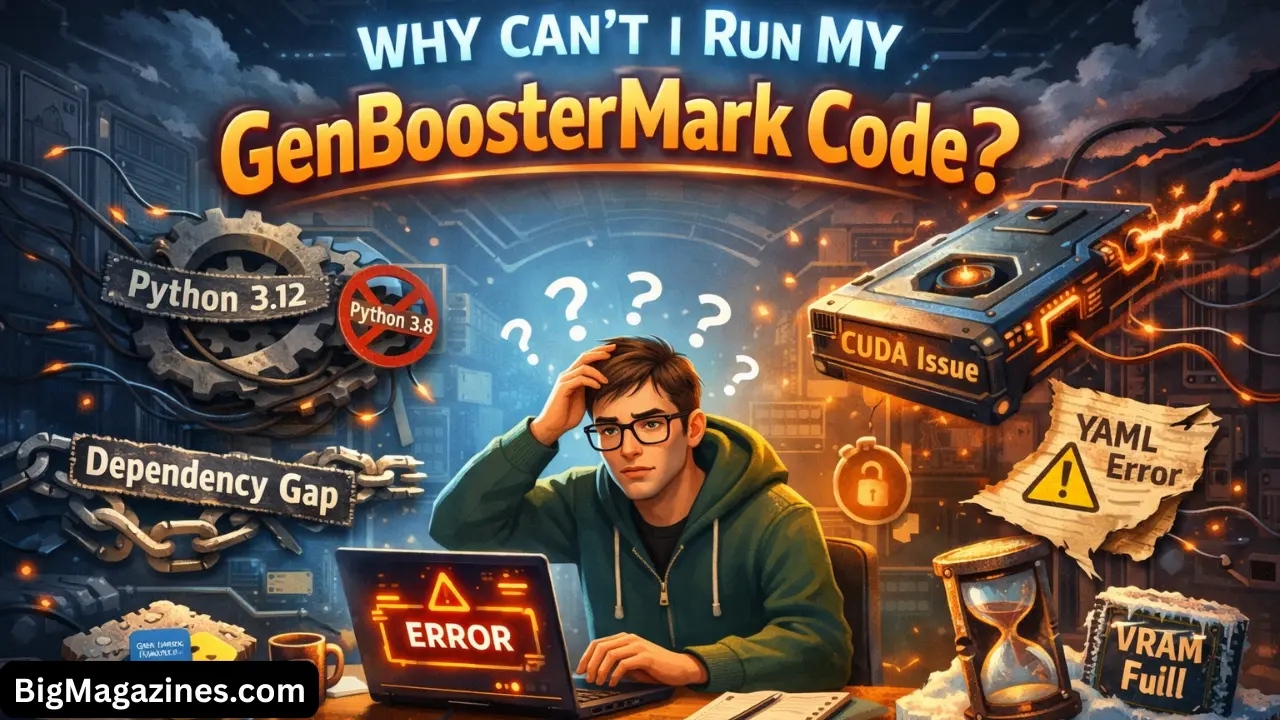
When your GenBoosterMark execution fails, the most common reason is a “Version Trap.” Many users assume that having the newest version of Python is always better. However, most AI benchmarking tools are built on specific versions of libraries that were tested on older environments. To understand the root of the problem, it helps to look at how standardized performance benchmarks interact with your system’s hardware. If your computer is using a version that is too new, the “hooks” the code uses to talk to your hardware simply won’t exist. This leads to the frustrating experience where you click run and nothing happens.
Another massive roadblock is the Dependency Gap. In the AI world, libraries rely on each other in a fragile chain. If you have a specific version of a math library but your GenBoosterMark code requires a slightly older one, the code might crash before it even starts. This is why many people ask “why can’t I run my GenBoosterMark code”—they have the right tools, but the tools aren’t “shaking hands” correctly. When these versions don’t match, the software enters a state of confusion, refusing to execute any commands to protect your system from crashing.
Step-by-Step Problem Solving Guide to Run GenBoosterMark Code
To fix these issues, you need to isolate your project. The best way to run your GenBoosterMark code successfully is to use a Virtual Environment. Think of this as a private “bubble” where you can install exactly what the code needs without interfering with the rest of your computer. You can create one easily using a tool like Conda or venv. Once you are inside this bubble, you can install the specific versions listed in the project’s requirements file.
If the code still won’t move, check your Command Line instead of your code editor’s “Run” button. Editors like VS Code sometimes use the wrong Python path. By manually typing python main.py in your terminal, you see the real error messages that the editor might be hiding from you. This transparency is the key to understanding why your GenBoosterMark code is stuck.
| Priority | Action Item | Why it Matters |
| High | Create Virtual Env | Prevents library version “fights.” |
| High | Update CUDA Drivers | Allows the code to use your GPU. |
| Medium | Check Config Files | Incorrect YAML spacing can kill the script. |
Understanding the GenBoosterMark Ecosystem and Requirements
The GenBoosterMark ecosystem is built to measure high-level performance, which means it requires a lot of “permissions.” If you are on a Windows machine, for example, your computer might block the script from checking your hardware temperature or power usage for security reasons. If the script cannot get this data, it might just stop. This is a very common reason why you can’t run your GenBoosterMark code on a work or school laptop where security settings are strict.
Furthermore, look at your YAML configuration files. These are the instruction manuals for the benchmark. If there is a single extra space or a missing colon in that file, the entire system will fail to load. AI tools are very sensitive to “syntax,” meaning the way the text is written. A small typo in the settings file is often the invisible wall standing between you and a successful benchmark run.
Advanced Troubleshooting: Hidden Errors in GenBoosterMark
Sometimes the code starts but then “hangs” or freezes. This is often a Parallel Processing Deadlock. Because GenBoosterMark tries to use every part of your CPU and GPU at once, sometimes two different parts of the code try to use the same memory at the same time. They get stuck waiting for each other, and your screen just stays still. If this happens, try reducing the “Worker Count” in your settings to 1 to see if it moves.
Memory Leaks are another hidden enemy. If your graphics card doesn’t have enough VRAM (Video RAM), the benchmark will simply quit. You might think the code is broken, but in reality, your hardware just ran out of “thinking space.” To solve this, try running a smaller model or a shorter test. Understanding these hardware limits helps you realize that the reason you can’t run your GenBoosterMark code might just be a lack of physical resources.
Community Pitfalls: What Other Developers Miss
Many developers fall into the trap of using Hardcoded Paths. This means the code is looking for a folder like C:\Users\John\Desktop\Data, but your name isn’t John! If you downloaded the code from a tutorial or a friend, always check the settings to make sure the file paths match your own computer. This is a simple mistake, but it’s a top reason for GenBoosterMark execution errors.
Another common pitfall is failing to Initialize the Object. In many AI scripts, you have to “wake up” the engine before you give it a task. If your code skips the setup phase and goes straight to the benchmark, it will crash immediately. Always ensure that the “init” or “setup” functions are called at the very beginning of your script.
Case Study: A research team spent three days wondering why they couldn’t run their GenBoosterMark code. It turned out they were using a GPU driver from 2023, while the software required a 2025 update. Once they updated the driver, the code ran in seconds.
Tips to Prevent Future GenBoosterMark Issues
To make sure you never have to ask “why can’t I run my GenBoosterMark code” again, get into the habit of Version Pinning. When you install a library, don’t just type pip install numpy. Instead, type pip install numpy==1.21.0. This locks the version in place so that an automatic update doesn’t break your code next week.
Also, keep a log file. Most AI tools have a “verbose” mode that prints every single step the computer takes. Even if you don’t understand everything it says, having that log makes it much easier for a friend or an AI assistant to help you find the needle in the haystack.
Conclusion: Mastering Your GenBoosterMark Setup
In the end, running complex AI code is as much about managing your environment as it is about writing logic. The reason why you can’t run your GenBoosterMark code is usually a simple communication error between your software and your hardware. By following the steps of isolating your environment, checking your versions, and validating your paths, you can overcome almost any technical hurdle.
Don’t let a few error messages discourage you. Every “failed to run” message is just a puzzle waiting for a solution. Once you get your setup stable, you’ll be able to generate insights and benchmarks that can truly push your AI projects to the next level.
Read Also: Playing Games Blog PlayBattleSquare